
A job aid is external information
that a person uses
to reduce reliance on memory
while accomplishing a task.
I often tinker with my definition a bit. For instance, sometimes I want to move the “reliance on memory” part up a line, but I don’t like the way the sentence flows. More important than the word order are the elements:
Information. Used. Less memorization. Accomplishment.
The what
I’ll expand on each element in other posts. Here’s the gist:
-
- Job aids deal with information, not skills. If you’re skilled at something, you’ve learned it and you’re fluent in applying it successfully. Stored in memory, retrieved from memory in appropriate circumstances.
- If a job aid isn’t used while someone carries out a task, it’s not really a job aid. Job aids support on-the-job performance.
- Reducing reliance on memory is how a job aid provides support. Most tasks involve some level of information. You can store information inside your head, or outside. Inside costs more, so you should consider where best to apply limited resources like time, money, and attention.
- An accomplishment, in this context, is not simply an outcome. It’s a result that meets requirements.
On that last point: not every “requirement” is required. If you don’t expect your new insurance agent to calculate flood insurance premiums as rapidly as a five-year veteran, then speed isn’t a requirement for new hires.
Sometimes — more often than officialdom likes to admit — good enough is good.
That’s the “what” part of job aids in 200 words or so.
On to the “what for”
Job aids help people produce useful results even when they don’t know how.
Probably you don’t know much about trade-in allowances for hyperspace teleporters. Even so, with the following chart, there’s a good chance you can figure out the trade-in value for a 2016 Parsec B teleporter from the Small Batch price level.
Give it a shot before reading past the chart.
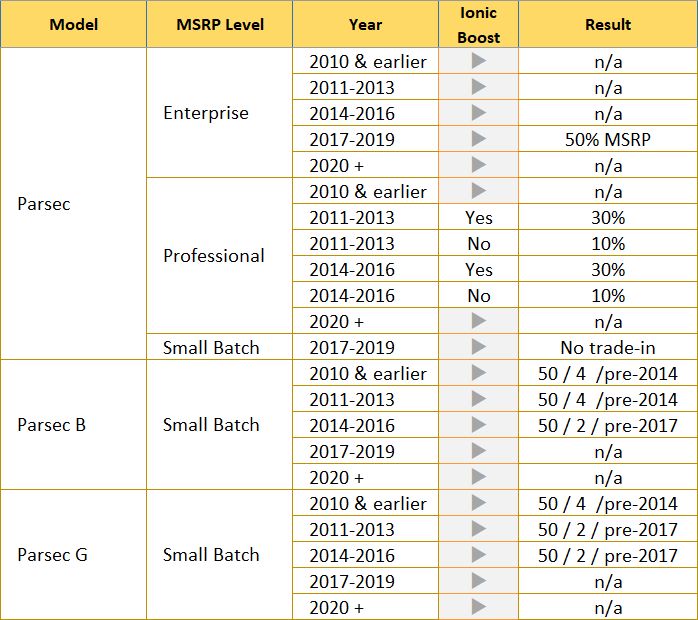
The answer is “50 / 2 / pre-2017.” It’s correct even if you haven’t yet learned what it means (50% of original MSRP, less 2% per year for each year prior to 2017).
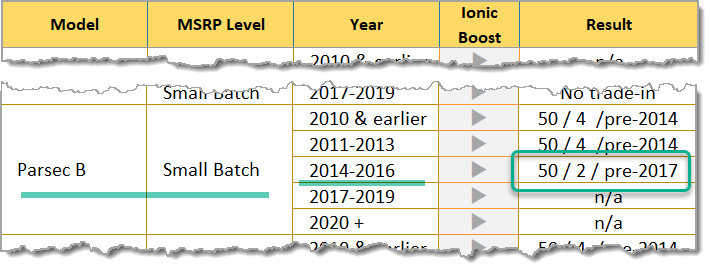
Otherwise: you didn’t really need to know what a hyperspace teleporter is. You didn’t need to know the names of models, nor what the price levels meant, and for this question you didn’t need to know what an ion boost is (an option offered only for certain models, and never for the Parsec B).
In the real-life example on which the teleporter trade-in job aid is based, there were eight possible results (including “n/a,” which here means no trade-in) for some three dozen combinations of models, price levels, year range, and ion boost.
That’s a lot of information to store inside someone’s head, especially if they don’t get a lot of trade-in queries at Maxine’s Teleporter Emporium.
The why
Giving Danny the receptionist this chart, and maybe 10 minutes of explanation and 10 of practice, means that Danny is almost certainly going to succeed at telling somewhat what trade-in their old teleporter might qualify for…
Because he’s got external information to use on the job that reduces reliance on memory while helping him accomplish that task.